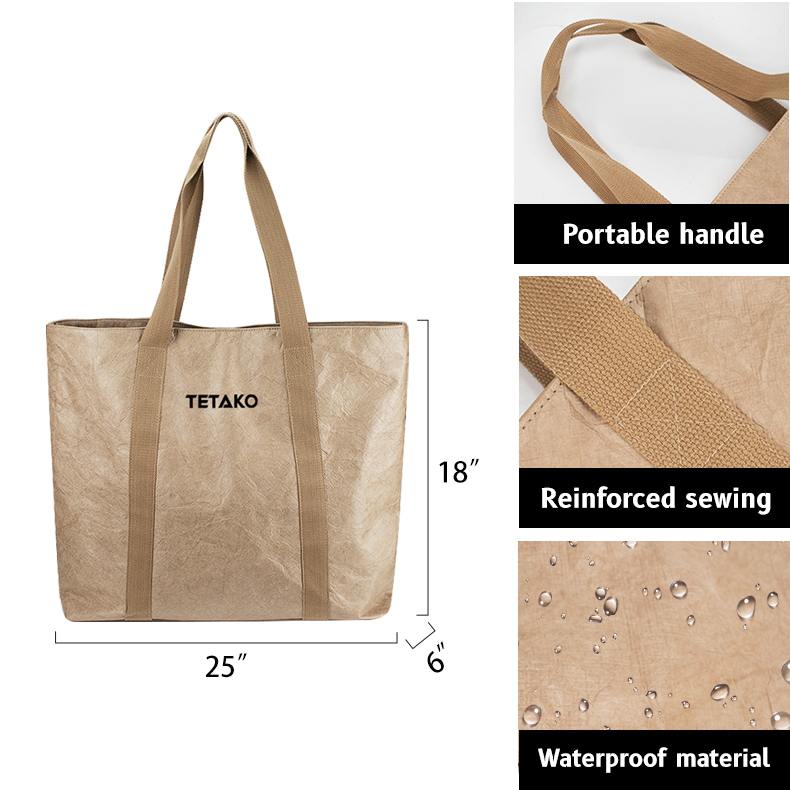
What is Tyvek and why should bag buyers pay attention to it
Tyvek is a material that defies easy categorization. It looks and feels like paper — lightweight, slightly textured, and flexible — but it behaves more like a high-performance synthetic fabric. Developed by DuPont, Tyvek is made from high-density polyethylene (HDPE) fibers that are flash-spun and bonded under heat and pressure, creating a nonwoven sheet that is simultaneously lightweight, tear-resistant, waterproof, and breathable. These properties make Tyvek an increasingly popular choice for bags used in shopping, travel, and outdoor activities, where the combination of minimal weight and maximum durability matters. Unlike cotton canvas that absorbs water and becomes heavy, or nylon that can fray at the edges, Tyvek maintains its structural integrity through wet conditions, repeated folding, and rough handling — qualities that explain its growing presence in the reusable bag market.
The material science behind Tyvek's practical advantages
Understanding why Tyvek performs the way it does helps buyers make informed decisions about when to choose it over conventional materials. The flash-spun HDPE process creates a web of continuous filaments that are randomly oriented and bonded, giving Tyvek its characteristic tear resistance — a tear that starts in one direction encounters crisscrossing fibers that resist further propagation. This is fundamentally different from woven fabrics, where a tear can follow a thread line. The material is waterproof because the dense, nonwoven structure prevents liquid water from passing through, yet it allows water vapor to escape — which means contents stay dry from external moisture while internal condensation does not build up. Tyvek is also 100% recyclable as HDPE (resin code #2), and many Tyvek bag products carry OEKO-TEX Standard 100 certification, confirming that the material has been tested for harmful substances and is safe for direct skin contact. For manufacturers targeting regulated markets, FDA 21 CFR compliance for food contact and REACH certification for the European market further expand Tyvek's application range.
Comparing Tyvek bags to traditional shopping and travel bag materials
When evaluated against the materials most commonly used for reusable shopping and travel bags, Tyvek occupies a distinctive position. A standard cotton canvas tote weighs approximately 200 to 300 grams empty and absorbs up to 30% of its dry weight in water when wet. A Tyvek bag of equivalent capacity weighs 50 to 80 grams and gains virtually no weight when wet. In terms of tear resistance, Tyvek outperforms both lightweight polyester and untreated nylon in the machine direction, though woven nylon with a ripstop grid remains stronger in controlled pull tests. For printability, Tyvek accepts silk screen printing in up to 12 colors, digital printing, and flexographic printing, allowing for detailed brand graphics that rival what is possible on coated fabrics. The main limitation of Tyvek is that it does not stretch — items packed into a Tyvek bag must fit within its fixed dimensions, unlike a stretchy knit bag that can expand around irregular shapes. This makes Tyvek better suited for structured packing scenarios such as grocery hauls, organized travel kits, and retail merchandise bags, rather than situations requiring elastic capacity.
A practical application: sourcing Tyvek bags for a retail or promotional campaign
For a business planning a branded reusable bag campaign — whether a grocery chain replacing single-use plastic, a conference distributing attendee swag bags, or a travel brand offering lightweight packing organizers — Tyvek presents a compelling option with clear manufacturing requirements. A qualified Tyvek bag manufacturer should be able to produce bags with 12-color silk screen printing for intricate brand designs, offer 3D digital modeling of bag prototypes before cutting begins, and maintain consistent production quality across MOQs (minimum order quantities) ranging from 1,000 to 5,000 units. A 15-day production lead time allows for seasonal campaign scheduling without excessive advance planning. Manufacturers like Allwin Bags, a Shenzhen-based producer with over 10 years of industry experience, a 2,000-square-meter facility, 200-plus skilled workers, and certifications including BSCI, ISO, OEKO-TEX, REACH, and CE, demonstrate the level of production infrastructure and quality assurance that brands should look for when selecting a Tyvek bag supplier.
Travel applications where Tyvek bags excel
The travel-specific advantages of Tyvek become clear when considering the demands of modern travel: weight limits on budget airlines, the need for compact packing, and exposure to unpredictable weather. A set of Tyvek packing cubes or organizer pouches weighs a fraction of their nylon equivalents and can be folded flat when not in use — an important consideration for travelers who practice one-bag carry-on travel. Tyvek toiletry bags provide a waterproof barrier that prevents leaks from spreading to clothing, while being thin enough to slip into the external pocket of a fully packed suitcase. For day trips at a destination, a Tyvek shopping tote folds into a compact self-pouch the size of a smartphone, making it easy to carry as a backup bag for spontaneous market purchases or beach supplies. The material's resistance to mold and mildew is an additional benefit for travelers moving through humid climates, as a Tyvek bag exposed to moisture will dry quickly without developing odors — a common problem with cotton bags in tropical conditions.
Sustainability positioning and end-of-life considerations
Tyvek's sustainability story is nuanced and worth understanding accurately. The material is petroleum-based, which means its raw material footprint is similar to other synthetic fabrics like polyester and nylon. However, Tyvek is 100% recyclable as HDPE, and recycling programs for polyethylene materials are widely available in most developed markets — a significant advantage over mixed-material bags that combine cotton, polyester, and leather trim into a non-recyclable composite. The material's extreme durability also extends its useful life compared to cotton totes that fray or polyester bags that delaminate, meaning fewer bags need to be produced over time to serve the same purpose. For brands positioning their reusable bag programs as sustainability initiatives, Tyvek's OEKO-TEX certification provides verifiable, third-party documentation of material safety, which is more concrete than vague claims of being "eco-friendly" or "green." The combination of long service life, recyclability, and certified material safety creates a credible sustainability narrative that holds up under scrutiny better than many alternative materials.a

 Hot News