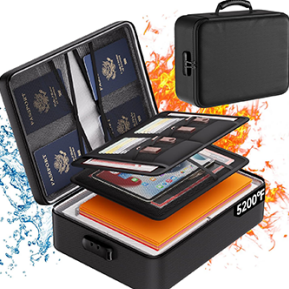
When a fire breaks out, the first instinct is to protect people, and the second is often to protect what cannot be replaced: family photos, hard drives, passports, and the electronics that hold so much of our digital lives. A fireproof bag is the most practical home defense for these items, but the honest answer to whether it can save your electronics is yes, within clearly defined limits. A fireproof bag protects its contents from heat and flame for a limited window, typically 30 to 60 minutes at a rated maximum temperature, which gives you and your belongings precious time, but it does not promise that a phone or laptop will emerge undamaged from every fire. Understanding how these bags work, what heat actually does to electronics, and how to use them correctly is the difference between false confidence and genuine protection.
What a Fireproof Bag Can and Cannot Do for Electronics
A fireproof bag is engineered around a simple principle: slow down heat transfer long enough for the fire to be controlled. Most quality bags combine a silicone-coated fiberglass outer layer, which resists flame and has a very high melting point, with an inner insulating layer that reflects radiant heat away from the contents. The result is a thermal barrier that keeps the interior significantly cooler than the exterior for a rated period. For documents and paper records, this protection is often complete: paper only begins to char at temperatures above roughly 200 degrees Celsius, and a well-designed bag keeps the interior well below that threshold for its rated duration. Electronics are a different story. A typical lithium-ion battery can be damaged by sustained exposure to temperatures above about 60 degrees Celsius, and circuit boards and screens degrade at temperatures far below the point where a device would visibly melt. This means a fireproof bag can dramatically improve the odds for external hard drives, memory cards, and USB flash drives, which have no battery and no moving parts, while phones, tablets, and laptops face a tougher test because the heat that reaches them can still stress the battery or damage internal components.
Heat Ratings and Time Limits: Reading the Specs Correctly
The numbers on a fireproof bag matter more than the marketing language around it. A rating of 1000 to 2000 degrees Fahrenheit for 30 to 60 minutes tells you the maximum external temperature the bag can withstand and how long it can hold that line. For electronics, however, the interior temperature curve matters just as much as the exterior rating. A bag can survive a fire while the interior still climbs high enough to damage a battery. When evaluating a fireproof bag, look for the tested interior temperature in addition to the exterior rating, and check whether the test was performed on the exact size you plan to buy. Larger bags take longer to heat through but also contain more air volume, so real-world results depend on the specific product. This is why serious buyers ask manufacturers for test certificates and standardized test conditions rather than relying on pictures and slogans.
Choosing the Right Fireproof Bag Design for Electronics
Beyond fire protection, the way the bag is organized determines how useful it is for electronics. A fireproof bag with a large capacity and multiple compartments keeps a laptop, external drives, chargers, and backup batteries separated and protected, so items do not crush one another while the bag sits in a safe or closet. A sturdy metal build adds structure, prevents the bag from collapsing in on its contents, and provides a rigid barrier during handling. Practical touches such as a 3-digit combination lock and a comfortable handle make the bag easier to use under stress, when every second counts. The combination lock also deters casual theft, though it is worth remembering that a lock is a convenience feature, not a security guarantee during a fire. The goal is a bag you actually use: electronics stored in a fireproof bag are only protected when they are inside it, so ease of daily access is part of the safety system.
Realistic Scenarios: What Actually Survives a Fire
Let us be honest about outcomes. In a typical house fire that is extinguished within the rated window, a fireproof bag frequently brings external drives, memory cards, and paper documents through intact. Solid-state drives and flash storage are especially good candidates because they have no moving parts and tolerate heat better than spinning hard drives. A spinning hard drive is more vulnerable because heat can warp the platters and affect the read heads, and the bag cannot prevent physical shock if the drive is dropped during evacuation. Phones, tablets, and laptops sit at the riskier end: even if the device looks fine afterward, the battery may have been stressed, and manufacturers generally recommend replacing batteries that have been exposed to high heat. The practical takeaway is to store the things that are truly irreplaceable, such as backups, photos, and documents, and to keep a cloud or off-site backup as a second layer of protection for the devices themselves.
Sourcing Fireproof Bags: What Buyers Should Verify
For brands and retailers considering a fireproof bag product line, the same logic applies at purchase scale. Ask the manufacturer to state the layering structure in writing: how many layers of fiberglass, what type of insulating material, and whether the bag meets any recognized testing standards. Confirm the rated temperature and duration in the product specification, and request test reports if the claim is a headline feature. A manufacturer with experience producing fireproof bags for document protection, built with large-capacity multi-compartment layouts, sturdy metal construction, and secure locking hardware, can usually provide these details confidently because the product was engineered around them. In our own manufacturing facility, we have produced such bags for clients worldwide and found that buyers who ask the right questions up front receive exactly the protection their product description promises.
Q: Will my phone survive a house fire inside a fireproof bag?
A: It depends on the duration and intensity of the fire. The bag protects against heat only for a limited, rated period, and the interior temperature still rises over time. Phones are more sensitive than documents because batteries and displays tolerate less heat, so treat the bag as risk reduction rather than a guarantee.
Q: What should I store in a fireproof bag?
A: The best candidates are items that are hard to replace and tolerate heat well: external drives, USB flash drives, memory cards, passports, birth certificates, and backup documents. Store phones and laptops only as a last resort, and always maintain an off-site backup.
Q: How do I verify that a fireproof bag actually works?
A: Do not set your bag on fire. Verify the manufacturer's rating, ask for test certificates from a recognized laboratory, and confirm that the rating matches the exact size you purchased. Inspect the seams and zipper periodically, because heat protection is only as strong as the weakest point.



 Hot News