Why a Puffer Tote Suits a Short Trip
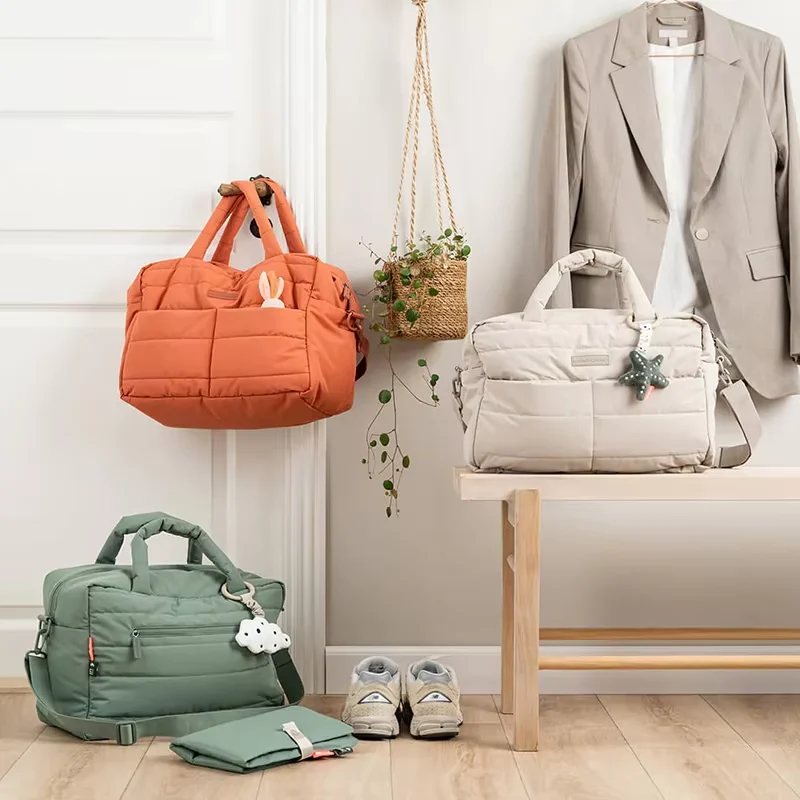
A puffer tote bag earns its place on a weekend trip for a reason that has little to do with fashion. Its quilted shell is soft, so the bag compresses into the remaining space in a car boot or squeezes under a seat, and it weighs very little even before it is packed. That combination means the bag itself does not consume the luggage allowance that a structured weekender would. The soft construction also behaves well in transit: a quilted bag absorbs small knocks against the contents instead of transferring them, which is reassuring when a camera or a tablet is inside. The trade-off is worth stating plainly. A puffer tote has little structural rigidity, so it will not hold a crisp shape when partly packed, and it offers less protection against crushing than a hard or framed bag. On a two-night trip where the bag travels in a car or in an overhead bin and is not checked, those limitations rarely matter. Understanding what the bag does well is what keeps the packing list realistic.
What the Bag Can Realistically Hold
Before packing, it helps to agree on a realistic load rather than a theoretical one. A medium puffer tote bag generally takes clothing for two days, a compact toiletry kit, a laptop or a tablet, a folded blanket or scarf, snacks and a water bottle, provided the clothing is rolled rather than folded flat. Three items push a puffer tote bag past comfortable limits: shoes, a hairdryer or similar bulky appliance, and a second bag carried inside it. Shoes should go in a separate compartment or an outer pocket if the design includes one, because putting them at the base of a soft bag lets the weight settle directly onto anything soft above them. Since the shell has no frame, weight distribution does the structural work that a puffer tote bag cannot do on its own.
Packing by Category, Not by Quantity
The most reliable way to pack a soft bag is by category, because categories determine where things sit. Because a puffer tote bag has no internal frame, the order in which items go in matters more than in a structured case. Clothing goes in first, rolled and placed as the base layer, with heavier items such as jeans and a jumper flat at the bottom of the bag rather than stacked in the middle. Cozy items come next: a scarf, a beanie, a pair of thick socks and a light throw, which are exactly the items that fill the awkward gaps between clothing rolls and, being soft, compress under other contents without being damaged. Toiletries go in a separate pouch rather than loose in the bag, because a leaking bottle in a quilted shell spreads through the padding and is difficult to clean. Technology goes in last and stays accessible, since a laptop or tablet is usually needed during the journey. A small quick-access zone near the top of the bag should hold the phone, a cardholder, headphones and a charging cable, so the bag does not have to be opened fully at a service station. Food and drink complete the list: a water bottle that fits an external pocket, and snacks that will not crush.
What Not to Bring
Because a soft bag has no frame, a short list of exclusions prevents most problems. Anything sharp or with a hard corner, such as a heavy toolkit or a rigid box, should not be packed directly against the quilted shell, because it will abrade the lining from the inside. Glass containers are best replaced with flexible alternatives, since a soft bag transfers compression rather than absorbing it. Very heavy items should stay out altogether, because without a reinforced base or frame the weight will pull the bag out of shape and put strain on the handle anchors. And anything that must stay completely dry should travel in its own water-resistant pouch, because a puffer tote bag shell is often water-resistant rather than waterproof, which is a meaningful difference in a downpour.
A Practical Sourcing Scenario: Specifying a Puffer Tote for a Weekend Range
Puffer tote bags are usually sold as part of a travel range rather than as a single item, and the specification work happens before the packing list ever matters. Consider an anonymous programme in which a brand needed a weekend travel range built around one soft silhouette. The specification defined the quilt density and fill so the bag would hold its shape when partially loaded, a water-repellent finish on the shell, a lining that would not fray against hardware, a main zip sized to open wide enough for rolled clothing, and a reinforced handle anchor because the bag would be lifted by one handle when full. Because the same platform was used for a smaller tote and a larger one, the shell, zip and handle specification were shared, and the fill density was the only variable that changed. A brief of this kind can typically be sampled in three to five working days without a logo and seven to nine working days with branding applied, with a common minimum of 500 pieces per style and mass production in roughly thirty to thirty-five working days after approval.
Frequently Asked Questions
How much can a puffer tote bag hold for a weekend trip?
A medium puffer tote bag usually takes two days of clothing, a compact toiletry kit, a laptop or tablet, a scarf or throw and some snacks, provided clothing is rolled rather than folded. Its limits appear when shoes, bulky appliances or a second bag are added, since the soft shell offers no frame to carry their weight.
Is a puffer tote bag good for a flight?
It works well as a personal item or carry-on on short trips, because it is light and compresses into small spaces. For a two-night trip, a puffer tote bag is usually easier to stow than a structured bag. Because the shell is usually water-resistant rather than fully waterproof and offers limited crush protection, anything fragile or sensitive to moisture should travel inside its own protective pouch.
Should a puffer tote bag have a zip closure?
A main zip is worth specifying for a travel-oriented puffer tote bag, since a soft open bag can spill when set down or lifted by one handle. If the design keeps an open top for easy access, an interior slip pocket for valuables is the practical compromise.

 Hot News